Many visitors highlight South America as an ideal destination for photographers and filmmakers. Its towns, people, and natural landscapes offer a unique array of images and unique shots. However, the top tourist attractions in Bolivia stand out for their singular characteristics. Whether it’s its charming cities or its breathtaking natural areas, you’ll find the perfect setting for that dreamlike memory.
Nevertheless, those who visit this magical destination will discover the joy of local photography. We’re referring to the imposing Salar de Uyuni. We understand that you’ve seen at least one photo of this place, and at the same time, you may have many questions about it. Therefore, the Machu Travel Peru team wants to share everything you need to know to make the most of this world-renowned photographic landmark.
Discover all about the best photos in the largest salt flat in the world
- About the Uyuni Salt Flats, Bolivia
- What makes the Uyuni Salt Flats a unique photography destination?
- Best time of year to photograph the Uyuni Salt Flats
- Creative photography ideas for stunning Uyuni shots
- Essential photography tips for beginners
- Salar Uyuni photo checklist
- FAQs about photographing Uyuni
About the Uyuni Salt Flats, Bolivia

In case you weren’t already familiar with it, the Salar de Uyuni, or Uyuni Salt Flats, is truly a jewel of nature. It boasts a unique formation resulting from the evaporation of a prehistoric lake, leaving behind a vast white expanse. Today, it’s one of South America’s most impressive destinations, spanning over 10,000 square kilometers. Its significance is such that some researchers estimate it holds more than half of the world’s lithium reserves.
In addition, its unique characteristics have earned it various designations, such as the world’s largest and highest salt flat. On top of that, its location is another key factor, as Uyuni itself is a unique and majestic place. This area, known as Uyuni, is unlike any other, thanks to its exciting diversity and surrounding history. Its active volcanoes, coral islands, local communities, and breathtaking landscapes perfectly complement the panorama.
How to get there

First, you have to consider its location; the Salar de Uyuni is in southeastern Bolivia, near Chile and Argentina. Those who wish to visit it will most likely want to combine their trip with visits to those two countries. Even so, most people choose to travel from Bolivia’s capital. To clarify how to get from La Paz to Uyuni, or other options, we present more information below:
- From La Paz, Bolivia: This is the most popular option as it’s part of the classic tour of the Andean country. Many tourists structure their trip to see the best of the country, ending with a visit to Bolivia’s salt flats. The classic tour standardizes the route, passing through places like Oruro to enjoy other attractions.
- From San Pedro de Atacama, Chile: Some adventurous travelers who have already explored neighboring Chile choose this alternative. This option is excellent for complementing your visit to the Salar de Atacama. Nonetheless, you’ll find more limited options for attractions and places to complement your experience.
- From Tupiza, Bolivia: Tupiza is the closest town to the border with Argentina, so it is another important route. Even though it’s the least popular option, it also has some noteworthy features. Among the main ones is the possibility of connecting with nearby nature reserves or accessing some Argentinian cities.
What makes the Uyuni Salt Flats a unique photography destination?

Beyond its general characteristics, Uyuni’s unique features make it a truly exceptional destination for photography. Among the most notable are its distinctive optical illusions, which are highly popular with photolovers. Furthermore, its pristine white sand offers unique opportunities to capture unforgettable images. This, combined with the photographer’s creativity, makes it a true jewel of South American photography.
Best time of year to photograph the Uyuni Salt Flats

Okay, now let’s get into a slightly more specific and definitely one of the most important aspects. Deciding when to travel is as crucial as having a good camera or thinking about composition. This is because both seasons have their own unique characteristics and features to enjoy the world’s largest salt flat in photography. Here are the key differences to help you decide.:
Dry season

The dry season runs from May to October and features minimal rainfall. This turns the salt flats into a vast desert landscape, perfect for forced-perspective shots. Those planning a trip to Salar de Uyuni will see a pristine white expanse with completely clear skies. Besides, its distinctive polygonal pattern makes it even more striking to the eye and, of course, to the camera.
Rainy season

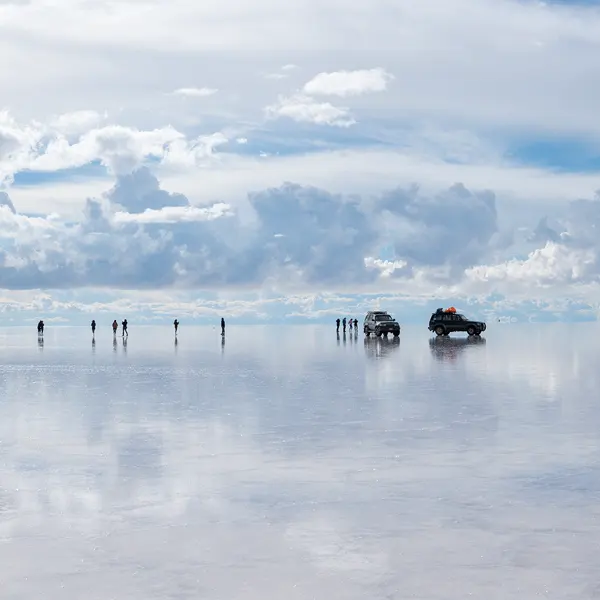
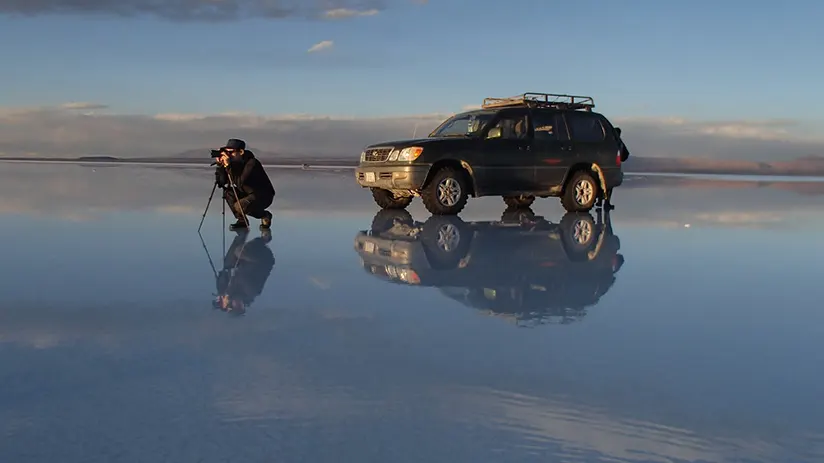
Between December and April, visitors can experience the rainy season, iconic for its pool-like effect. Many tourists love this time because Bolivia’s salt flats become the world’s largest mirror. A thin layer of water floods the salt flats, creating this globally sought-after effect. Landscape and panoramic photos are the most popular during this time, but the photographer’s skill is undoubtedly key.
Creative photography ideas for stunning Uyuni shots

Once you decide when to travel, the next step is planning what photos to take. Although this is entirely up to the photographer, it’s one of the best aspects to consider before traveling. Looking at references, reading about techniques, or watching tutorials will greatly help enrich and clarify your ideas. Even so, we present some of the most popular options you could choose:
Perspective shots

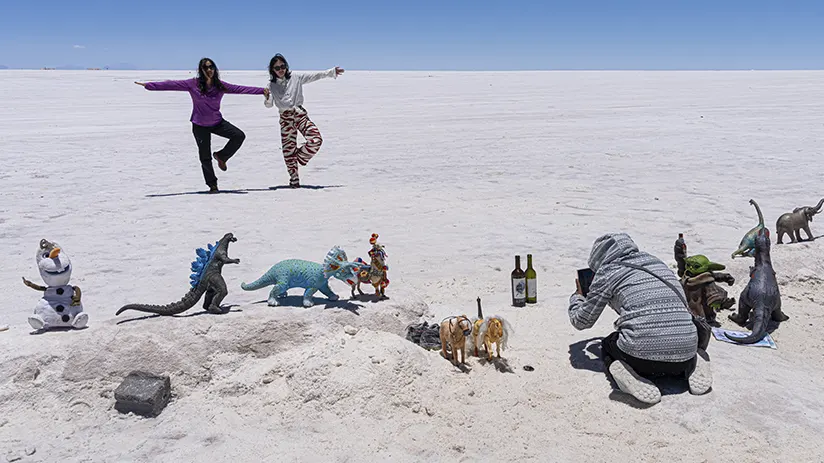
This technique is ideal for those traveling during the dry season and is one of the most versatile options. Travelers will have countless possibilities and combinations to create and compose. From people against people, people against objects, and even objects against objects. The main thing here is to plan what kind of final product you want to achieve; the list is immense.
Besides being one of the most common alternatives for travelers, it’s one of the most classic and seemingly easy. You have to consider some factors, such as sunlight, the distance between objects, and the photographer’s position. On top of that, with a little patience and caution, you’re sure to get some fun and eye-catching photos.
Reflection shots

Reflection photos are perfect for those visiting during the rainy season who want to approach this magical natural mirror. For this option, you should carefully consider the surrounding landscape and the time of day. Many photographers choose to do it at sunset when the violet and warm tones of the sky blend.
Night sky
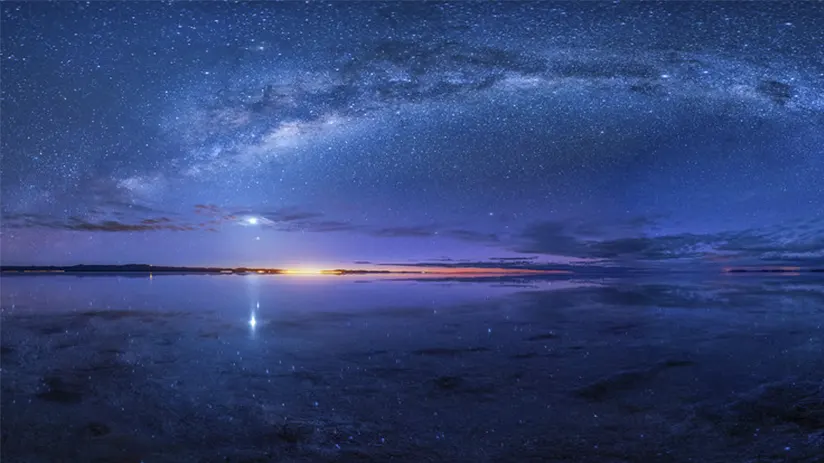
Although it could be a variation of the previous shot, this one stands out for capturing the majestic night sky. To capture these kinds of photos, visitors must go during the rainy season with a fast, wide-angle lens. Even though some smartphones have good image quality, it’s better to have a camera that captures all the available light. The dreamlike views and soft atmosphere make this a dreamlike landscape.
Other ideas
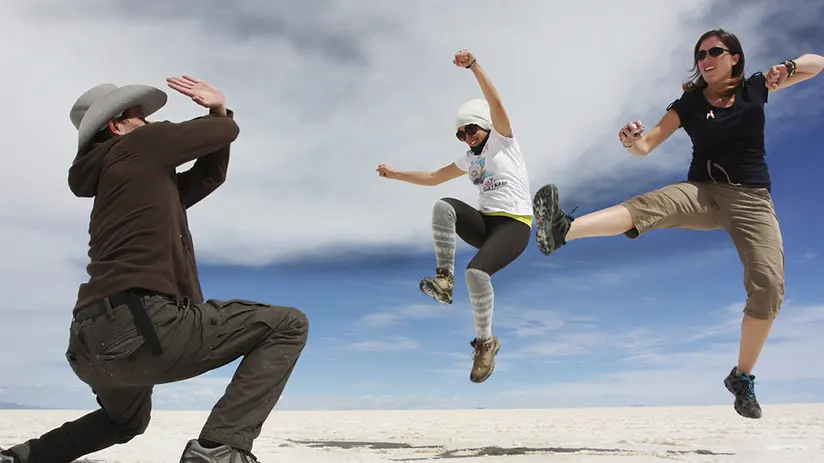
Whenever you want, you can take a classic photo of yourself jumping or simply smiling. Those who want to be more practical can opt for photos that don’t require much preparation. Often, simply doing it will be fun and something you’ll remember. Remember, this is a place to enjoy yourself and disconnect from everyday life, so take it easy.
Essential photography tips for beginners
Those who are Uyuni beginner photographers, or even experienced ones, will definitely want to consider a few suggestions. We understand that this destination is like no other in the world, and photography is no exception. These Salar de Uyuni photo tips will greatly help you improve your composition and overall experience. Here are some of the most popular and noteworthy tips to think about:
- The photographer’s position is crucial depending on the type of photograph they want to take. For example, to capture the beautiful Bolivian Andean landscape and, primarily, the sky, the photographer should be standing. On the other hand, for better perspective shots, it’s best to position the camera as close to the ground as possible.
- For better composition, it’s essential to consider the distance of your subjects, if you have any. We suggest ensuring your subjects are close enough to the camera to capture sharp images. The farther away they are, the more difficult it will be for the camera to focus on them effectively.
- Explore other iconic nearby locations, whether they relate to adventure, nature, or people. For example, a photograph of the Red Lagoon in Bolivia is ideal for those who love unusual attractions. Photographing local communities and their traditions is equally exciting.
- Among the tips for taking photos at Bolivia’s salt flats, one of the most important is to be mindful of shadows. To achieve the desired depth effect, your subjects must always face the sun. Shadows in the shot can reveal the optical effects you’re trying to use.
- If you have a camera, make sure it has some degree of manual controls. The settings will vary depending on the final result and the conditions in which you take the photo. Nonetheless, you should at least pay attention to exposure and white balance.
- On the other hand, those carrying only a smartphone will need to be careful to optimize their battery life. Power outlets won’t always be available during your trip, so using only one device can be limiting. As for photo settings, you should consider the same ones as with a traditional camera.
- One of the best ways to visit many photographic locations is by opting for a specialized photography tour. Many private tours can dedicate their itinerary to finding the perfect shot, and of course, they offer constant assistance. In addition, you have the opportunity to try the traditional Bolivian food during your Uyuni trip. Nonetheless, you must prepare to pay more than usual to enjoy this type of experience.
Salar Uyuni photo checklist
Another main Salar Uyuni photography tip is to make a checklist to ensure you have everything you need. This is the best way to avoid forgetting anything, whether for a special activity or your trip in general. We recommend writing everything down weeks in advance so you can purchase any items you don’t already have. Here are the essentials for your Uyuni travel photography:
- Camera or smartphone
- Extra batteries, a power bank, and memory cards
- Additional photography equipment (tripod, filters, lenses, etc.)
- Props (toys, bottles, objects, etc.)
- Lightweight hiking clothing
- Comfortable and sturdy footwear
- Personal documents and copies
- Sunscreen, hats, and umbrellas
Remember that for the safety and care of your photography equipment, it’s advisable to use protective bags. This will help protect all your gear from salt, humidity, snow, or any other eventuality. Moreover, storing your equipment when not in use will greatly help prevent damage. Every little precaution will help avoid any mishaps during your experience.
FAQs about photographing Uyuni

What is the best time of year to photograph Bolivia’s salt flats?
The best time depends on the style of photos you want. For example, from May to November, the dry season offers a vast, cracked salt surface ideal for perspective shots. Nonetheless, from December to March, the rainy season creates the Uyuni mirror effect photography when a thin layer of water covers the flats. Both seasons are photogenic, but each produces completely different results.
How do you take good reflection photos at Uyuni?
For Uyuni mirror effect photos, visit during the rainy season and look for areas with shallow, still water. Shoot from a low angle to enhance symmetry, place your subject far from you for scale, and avoid windy moments that disturb the water. Golden hour light will help create softer, more dramatic reflections.
Can you capture great Uyuni photos with a smartphone?
Absolutely, smartphones can capture excellent photos thanks to good lighting and Uyuni’s naturally photogenic setting. Use the wide lens, tap to focus and adjust exposure, shoot during sunrise or sunset, and keep the lens clean. A small tripod, RAW mode, and editing apps can also further improve results.
How do you prepare for photography at the Uyuni Salt Flats?
Bring extra batteries, memory cards, microfiber cloths, and plenty of water to help you with smartphone photography in Uyuni. Wear layers for rapidly changing weather, sunscreen for the intense UV, and sunglasses to handle the bright white salt. If staying for sunset or night shots, pack warm clothes, snacks, and a tripod.
What props work best for perspective photos at Uyuni?
Small, bold objects like toy dinosaurs, bottles, hats, or shoes work great because the flat white surface removes depth cues, allowing fun scale illusions. Keeping props simple, colorful, and easy to position helps create more convincing perspective effects.
Is sunrise or sunset better for photos in Uyuni?
Both are beautiful, but the sunset tends to produce the most dramatic colors and softer reflections. Sunrise offers calmer conditions and fewer people, perfect for what you want: still water for mirror shots. The choice depends on whether you prefer solitude and soft pastels or vivid warm tones.
“THERE IS NO BETTER OPPORTUNITY TO TAKE A PHOTO THAN ONE WHERE YOU ARE NOT AFRAID TO SHOOT”
Remember that capturing the magic of this place is about experiencing its surreal beauty firsthand. Whether you’re dreaming of reflections, stunning sunsets, or creative shots, the right planning makes the difference. Plan your Uyuni photography adventure with Machu Travel Peru, and let us create a seamless journey and unforgettable experience. This Uyuni Salt Flats photo guide is a glimpse of the iceberg; for more information, consult with our advisors.
Bolivia has so much to offer, it can be hard to know where to start. With many years of experience in tourism in Bolivia. Machu Travel Peru is happy to help with anything regarding your trip to Uyuni Salt Flats and any tours around it. Make your Uyuni Salt Flats experience an unforgettable one! Contact Us today to plan your dream adventure!