Arequipa’s churches are among Peru’s finest examples of colonial architecture, best known for the Basilica Cathedral, the Iglesia de la Compañía de Jesús, San Francisco, Santo Domingo, San Agustín, and La Merced. Set within the UNESCO-listed Historic Center, most sit a few blocks from the Plaza de Armas. This guide to Arequipa churches covers their history, architecture, and visitor details.
A Guide to Arequipa’s Colonial Churches, Their History, and Architecture
- Why Arequipa’s Churches Are Famous
- The Main Churches of Arequipa’s Historic Center
- Santa Catalina Monastery
- San Juan Bautista de Yanahuara and Its Viewpoint
- Sillar Stone and Mestizo Baroque Architecture
- Walking Tour of Arequipa’s Churches
- Tips for Visiting Churches in Arequipa
- FAQs About Arequipa Churches
Why Arequipa’s Churches Are Famous
Arequipa’s churches are best known for sillar, a white volcanic stone. Masons quarried it in shades of white and soft pink from the nearby Misti and Chachani volcanoes. This pale volcanic stone gave Arequipa its nickname, the White City, and lends every temple the same tone seen across so many local buildings.
The design of these churches carries as much weight as their material. Working the soft volcanic stone, local carvers reshaped European Baroque forms into a regional style that added Andean plants and faces, now known as mestizo Baroque. This architectural blend helped establish Arequipa as a center of religious art and cultural heritage. It also placed them among the top things to do in Arequipa for history-minded visitors.
The Main Churches of Arequipa’s Historic Center

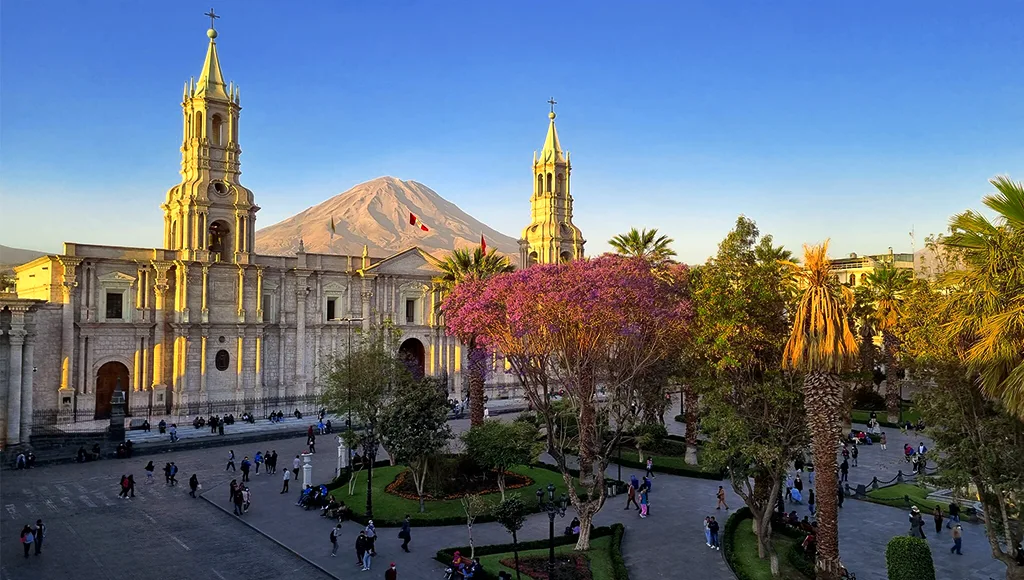
The main churches of Arequipa’s Historic Center stand within a short walk of the Plaza de Armas. Each one carries a different history, builder, and decorative style, from the neoclassical Cathedral to the carved sillar facade of La Compañía. The following six churches are the city’s principal colonial landmarks on the list of Arequipa attractions for those who want to understand the colonial era.
Basilica Cathedral of Arequipa
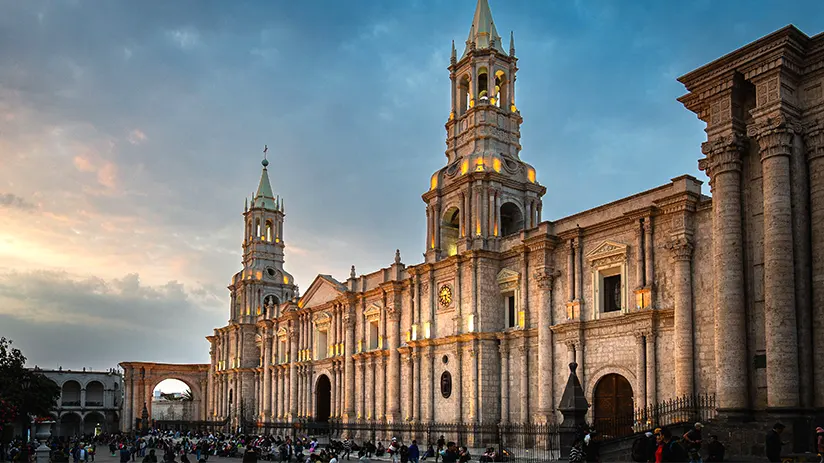
- Opening hours: Church Monday to Saturday 7:00 A.M. to 11:30 A.M. and 5:00 P.M. to 7:30 P.M.; museum Monday to Saturday 10:00 A.M. to 5:00 P.M.
- Entrance ticket: Church free; museum and towers about $2.70
- Best for: Travelers interested in religious art and city views
- Highlights: Belgian organ, marble altar, Vatican-flag basilica status
The Basilica Cathedral occupies the entire north side of the Plaza de Armas. Builders first raised it in the 17th century, but a fire in 1844 and then the 1868 earthquake destroyed much of that work. The architect Lucas Poblete rebuilt the site in the neoclassical style seen today, giving it a sillar facade of seventy Corinthian columns and two tall towers. The cathedral continued to suffer earthquake damage, since a 2001 earthquake brought down the left tower, which crews restored soon after.
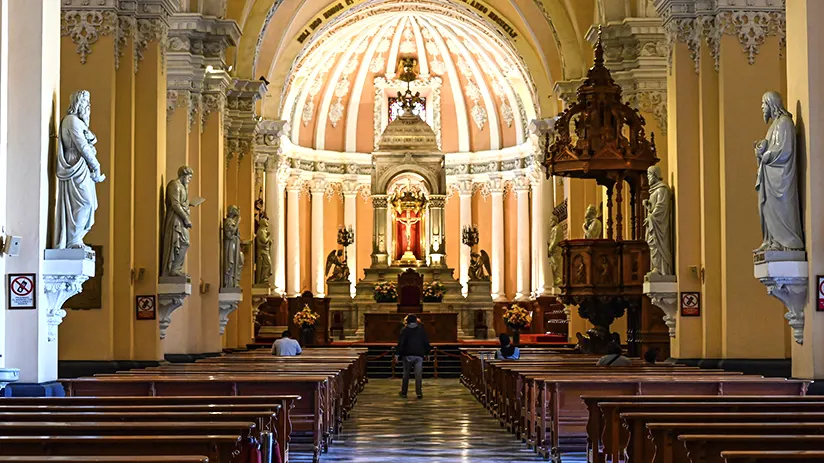
The Basilica Cathedral is one of the few cathedrals in Peru occupying an entire side of a main square. Inside, a Belgian organ from 1870 and an Italian marble altar sit beside a religious art museum. Its status as a basilica places it among fewer than 100 churches worldwide authorized to fly the Vatican flag.
Iglesia de la Compañía de Jesús
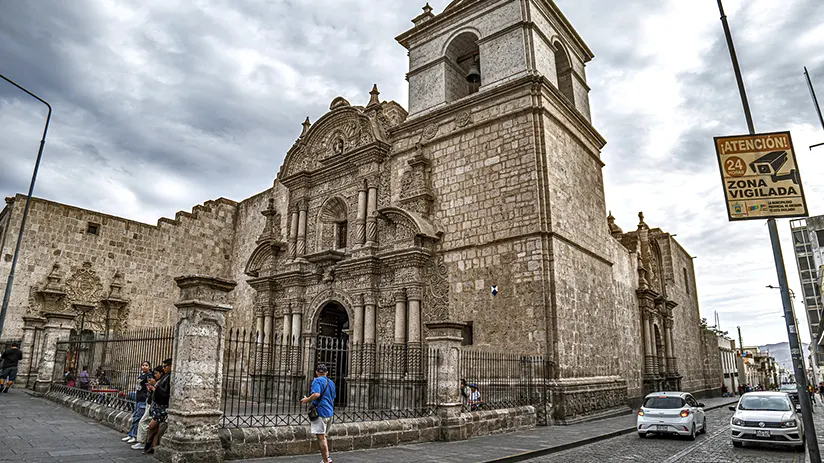
- Opening hours: Monday to Sunday 9:00 A.M. to 11:00 A.M. and 3:00 P.M. to 6:00 P.M.
- Entrance ticket: Church free; San Ignacio chapel about $1.40
- Best for: Visitors interested in colonial architecture and colonial painting
- Highlights: Mestizo Baroque facade, Bitti painting, San Ignacio chapel murals
The Iglesia de la Compañía de Jesús sits on the southeast corner of the Plaza de Armas. The Jesuit order, also known as the Company of Jesus, began the temple in 1578, though repeated earthquakes delayed its completion until 1698. Over those years, carvers cut its facade from white sillar in deep mestizo Baroque relief, blending European forms with Andean motifs and figures.
That facade is considered one of the finest examples of the Arequipa school, a style that spread from here to churches in other regions of Peru. Among its highlights, the main altarpiece carries gold leaf and a painting by the Italian artist Bernardo Bitti, who reached Peru in 1575. Beside it, the Capilla de San Ignacio adds polychrome murals of tropical plants and animals.
Church of San Francisco
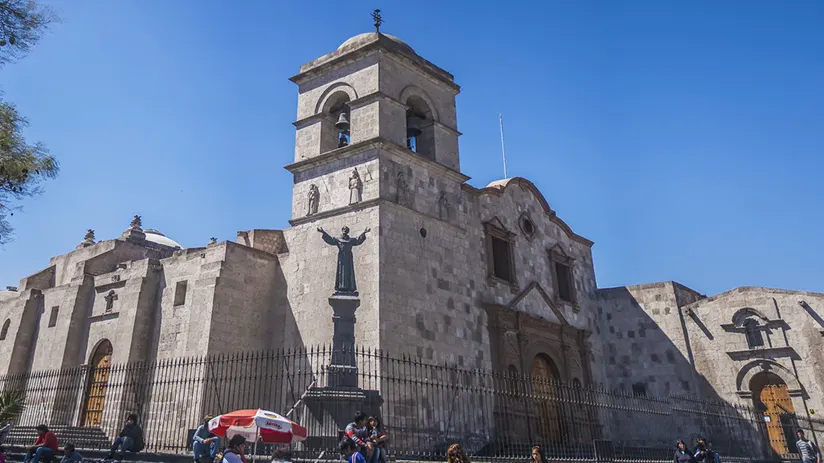
- Opening hours: Monday to Saturday 7:00 A.M. to 9:00 A.M. and 5:00 P.M. to 8:00 P.M.
- Entrance ticket: Church free; convent museum small fee
- Best for: Those interested in convents and colonial art
- Highlights: Cracked facade, third-order cloisters, colonial paintings
The Church of San Francisco stands three blocks north of the Plaza de Armas, beside its own small square. Franciscan builders broke ground in 1569, giving the complex more than four centuries of history. As for its design, the church follows the Andean Baroque style in tuff and sillar, built as a single hall under a brick vault.
A visible crack runs across the main facade, a reminder of the earthquakes the church has withstood over centuries. Behind it, the wider complex opens into the convent and the third-order cloisters, where colonial paintings and carved woodwork remain. Together these spaces form one of the larger religious groups in the historic center.
Church of Santo Domingo

- Opening hours: Monday to Saturday 7:00 A.M. to 12:00 P.M. and 3:30 P.M. to 5:00 P.M.
- Entrance ticket: Free or small donation
- Best for: Visitors tracing the city’s earliest religious orders
- Highlights: Carved sillar portal, working convent
The Church of Santo Domingo rises a few blocks east of the Plaza de Armas. The Dominican order reached Arequipa in 1540 and began the church in 1590, on the site of an earlier mission chapel. Here, builders raised the temple in sillar in the Baroque style.
Its main portal shows carved sillar reliefs typical of the mestizo Baroque, the work of local masons. The Dominicans have held this ground since those founding years, which ties the church to the beginnings of colonial Arequipa. The convent beside it still serves its religious community today.
Church of San Agustín

- Opening hours: Monday to Saturday 9:00 A.M. to 12:00 P.M. and 4:00 P.M. to 6:00 P.M.
- Entrance ticket: Free or small donation
- Best for: Travelers who like ornate facades
- Highlights: Richly carved portal, original vaulted sacristy
The Church of San Agustín stands at the corner of San Agustín and Sucre streets, southwest of the Plaza de Armas. The Augustinian order built the original temple in the 17th century in the mestizo Baroque style. The 1868 earthquake later left only the sacristy standing, so most of the current building dates from the reconstruction that followed.
Its carved sillar portal is one of the city’s most elaborate, with deep floral and figurative relief across two levels. The vaulted sacristy, the one part that survived, keeps its original decoration, which visitors can still see. That older ornament shows the design the rest of the church once carried.
Church of La Merced

- Opening hours: Monday to Sunday 9:00 A.M. to 12:00 P.M. and 4:00 P.M. to 6:00 P.M.
- Entrance ticket: Free or small donation
- Best for: Visitors after quiet cloisters
- Highlights: Mudéjar portico, domed transept, stone cloister
Finally, the Church of La Merced lies two blocks southwest of the Plaza de Armas, on La Merced Street. Founded in 1548, it is the oldest of the city’s main churches, though the temple standing today was finished in 1661. Above the transept rises a solid dome, a feature that sets the building apart from its neighbors.
That distinctive profile continues at the entrance, where the carved sillar portico follows a Mudéjar pattern, a Moorish-influenced style rare among the city’s churches. Its stone cloister and quiet courtyards are among the complex’s main attractions. The church also keeps a central place in Arequipa’s religious processions through the year.
Santa Catalina Monastery

The Santa Catalina Monastery is not a church but a walled convent, three blocks north of the Plaza de Armas. Viceroy Francisco de Toledo founded it in 1579. Afterward, the widow Doña María de Guzmán funded the project and became its first prioress. The monastery covers about 20,000 square meters behind four-meter volcanic stone walls, which gives rise to its nickname, ‘a city within a city.
As a result, for nearly four centuries, Dominican nuns from wealthy Spanish families lived here in near-total isolation. They paid large dowries to enter and stayed behind the walls nearly all the time. The complex holds six streets, three cloisters, a main square, and rows of private cells, all built from white and the pink stone of the Misti volcano.
The monastery stayed closed to the rest of the city until 1970. Then, when most of it opened as a museum, a small group of nuns kept the northern quarter to continue their religious life. The Great Cloister leads to the chapel and a picture gallery of colonial religious art, a highlight among Arequipa museums. A few nuns still live on the grounds today.
San Juan Bautista de Yanahuara and Its Viewpoint
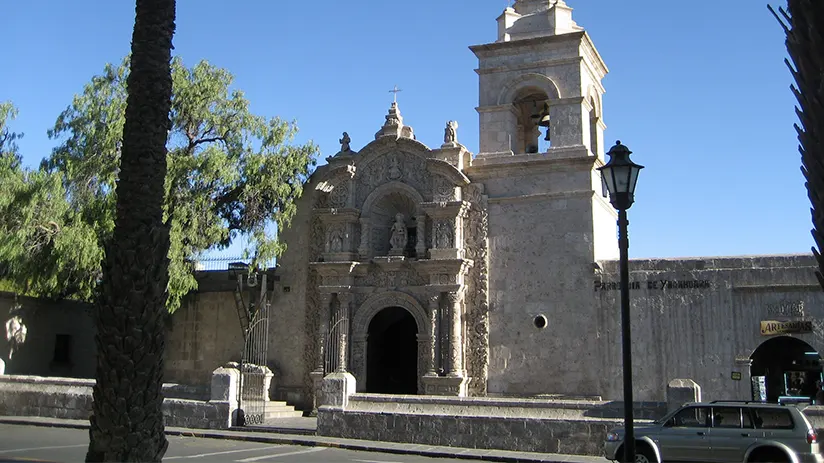
The churches so far all rise within the historic core, but one worth the trip sits outside it. The Church of San Juan Bautista de Yanahuara stands in the main square of Yanahuara, a traditional district about 2 km from the center across the Chili River. Workers completed it in 1750 in the mestizo Baroque style. Its sillar facade carries carved angels, flowers, and figures of saints, and the parish still holds weddings and baptisms for local families.
The reason most visitors cross the river, though, stands right beside the church. The Mirador de Yanahuara lines up a row of volcanic rock arches built in the 19th century, each one engraved with quotes from noted Arequipa writers and thinkers. Through those arches, the Misti, Chachani, and Pichu Pichu volcanoes frame the White City. Entry is free, since the viewpoint is a public space, and the late afternoon brings the clearest light.
Standing at the city’s edge, this neighborhood makes a natural close to a day among the churches. From here, many travelers look past Arequipa toward the countryside, often adding a Colca Canyon tour to the north. The district is best explored on foot, with quiet cobbled streets and white sillar houses at every turn.
Sillar Stone and Mestizo Baroque Architecture

Every church so far shares the same two traits, the stone and the design. Sillar is a porous rock formed from the ash of the Chachani and Misti volcanoes, found near the city in two shades, white and a softer pink. Its light weight let colonial masons cut deep detail into facades, which is why the material shaped nearly every church in Arequipa.
The same quality that made sillar easy to carve also made it fragile. Frequent earthquakes forced builders to raise thick stone walls and low, heavy towers that could ride out the shaking. The pale rock also reflected the strong Andean sun and kept interiors cool. The color gave Arequipa its name, the White City, a label tied to the temples and mansions of the center.
The decorative carving completes the city’s architectural identity. Mestizo Baroque took shape in the Viceroyalty of Peru, where local artisans set Andean flowers, birds, and faces into European forms in flat relief. This regional style, known as the Arequipa school, defines the colonial architecture of the city. Though each church applied it in its own way, as the table below shows.
| Church | Architectural style | Distinctive feature |
|---|---|---|
| Basilica Cathedral | Neoclassical | Sillar facade of seventy Corinthian columns, spanning the full north side of the plaza |
| Iglesia de la Compañía de Jesús | Mestizo Baroque (Arequipa school) | Deeply carved sillar facade and the muraled Capilla de San Ignacio |
| Church of San Francisco | Andean Baroque | Single hall under a brick vault, with a visible facade crack |
| Church of Santo Domingo | Baroque with mestizo relief | Carved rock portal on an early Dominican site |
| Church of San Agustín | Mestizo Baroque | Ornate two-level portal and an original vaulted sacristy |
| Church of La Merced | Baroque with Mudéjar portico | Solid dome over the transept and a stone cloister |
Walking Tour of Arequipa’s Churches
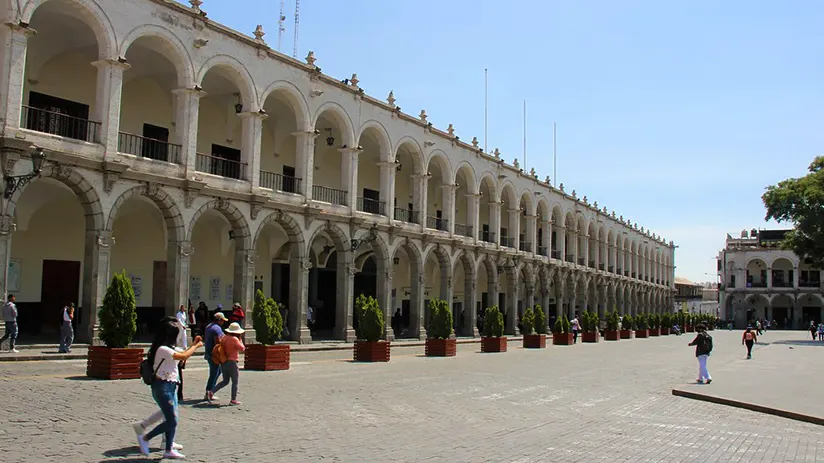
Since these sites cluster so tightly, the easiest way to take them in is on foot. A self-guided loop through the historic center covers the six main churches in a single morning. The route stays flat and compact, so it suits travelers who prefer to move at their own pace. Anyone who wants added context can join a guided walking tour in Arequipa, led by a local expert.
The loop begins at the Plaza de Armas, where the Cathedral and La Compañía face the square. From there it continues to San Agustín and La Merced, then turns toward Santo Domingo before closing at San Francisco. Santa Catalina fits in along the way for those who want at least an hour inside. Yanahuara rounds off the day for anyone with extra time to cross the river.
Tips for Visiting Churches in Arequipa

A little planning makes visiting these churches much easier. Most of these churches sit in the compact historic center, so a central base keeps everything within reach, and staying in one of the hotels in Arequipa near the Plaza de Armas puts the main temples a few minutes away on foot. That location suits a half-day route better than any other part of the city.
- Dress code: Cover shoulders and knees inside, since these are active places of worship.
- Admission: Enter the parish churches for free or a small donation, and carry small change for the museums and chapels, about $2.70 at the Cathedral, $1.40 at La Compañía, and near $14 at Santa Catalina.
- Peruvian soles: Several sites charge a small fee for their museums or chapels outside Mass hours, so carry Peruvian soles in cash.
- Opening hours: Visit in the morning or late afternoon and avoid the midday closure. For Santa Catalina, allow a longer visit within its 9:00 A.M. to 6:00 P.M. schedule, and arrive before the 5:00 P.M. last entry. Please check official sources before your visit.
- Mass times: Plan sightseeing around Mass, usually early morning and evening, and attend the service itself if you want to enter free at those hours.
- Photography: Check the sign at each entrance, and skip the flash to protect old paintings and altarpieces
FAQs About Arequipa Churches

What are the most famous churches in Arequipa?
Arequipa’s best-known churches are the Basilica Cathedral and the Iglesia de la Compañía de Jesús, both on the Plaza de Armas. Others include San Francisco, Santo Domingo, San Agustín, and La Merced, all built from white stone in the historic center.
Which church should I visit in Arequipa?
The Iglesia de la Compañía de Jesús attracts the most attention for its carved rock facade, a prime example of mestizo Baroque. The Basilica Cathedral ranks as the other essential stop, given its size and setting on the main square.
Is Arequipa Cathedral worth visiting?
The Basilica Cathedral is well worth visiting as one of the largest churches in the city and one of the few in Peru that spans a full side of a plaza. Inside, it holds a Belgian organ, a marble altar, and a religious art museum.
What is the oldest church in Arequipa?
By foundation date, La Merced is the oldest of the main churches, established in 1548, though the temple standing today was finished in 1661. San Francisco followed in 1569, and Santo Domingo began in 1590.
Are the churches in Arequipa free to enter?
Most parish churches in Arequipa are free to enter or ask only for a small donation. The Santa Catalina Monastery is the main exception and charges a set admission fee, while the Yanahuara viewpoint beside its church stays free.
Can you visit Arequipa churches on foot?
The main churches sit within a few blocks of the Plaza de Armas, which makes a self-guided walk the easiest way to see them. A compact loop of the historic center covers most of them in two to three hours.
What churches are near Plaza de Armas in Arequipa?
The Basilica Cathedral lines the north side of the Plaza de Armas, and the Iglesia de la Compañía de Jesús stands at the southeast corner. San Agustín, La Merced, and Santa Catalina all sit within a few blocks of the square.
What architectural style are Arequipa’s churches?
Most Arequipa churches follow the mestizo Baroque style, which adds Andean motifs to European forms carved into white sillar. The Basilica Cathedral is the main exception, rebuilt in a neoclassical design after the 1844 fire.
“STONE ENDURES WHERE MEMORY FADES”
The colonial churches of Arequipa gather centuries of history into a small, walkable center. From the neoclassical Cathedral on the Plaza de Armas to the carved facade of La Compañía and the sillar arches of Yanahuara, each building reflects the volcanic stone and mestizo Baroque style that shaped the city. Together they explain why the historic center holds UNESCO World Heritage status. A visit to the Arequipa churches traces a clear route through the colonial past of the White City.
Arequipa has so much to offer; it can be hard to know where to start. With many years of experience in the tourism sector, Machu Travel Peru is happy to help with anything regarding your trip to Arequipa and any tours around it. Let us help you make your Arequipa travel experience unforgettable! Contact us today to plan your dream adventure!