Rainbow Mountain in Peru is one of the most famous high-altitude hikes in South America, located near Cusco. Known for its striking mineral colors and dramatic Andean landscapes, it has become a must-visit destination for travelers seeking trekking experiences in Peru. This guide will help you understand everything you need to know about this destination.
Rainbow Mountain Peru: Everything you need to know before you go
- What Is Rainbow Mountain in Peru?
- Vinicunca Rainbow Mountain: The Classic Hike
- Palccoyo Rainbow Mountain: A Less Demanding Alternative to Vinicunca
- Vinicunca vs Palccoyo: Which One Should You Choose?
- What to Pack for Rainbow Mountain
- Best Time to Visit Rainbow Mountain, Peru
- Essential Travel Tips for Rainbow Mountain
- FAQs about the Rainbow Mountain
- Conclusion
What Is Rainbow Mountain in Peru?

Peru is home to several colorful mountain formations, with Vinicunca and Palccoyo being two of the best-known destinations near Cusco. The colors often appear more vivid under clear or partly sunny conditions. The journey through the high Andes is part of the experience, with dramatic mountain scenery along the way.
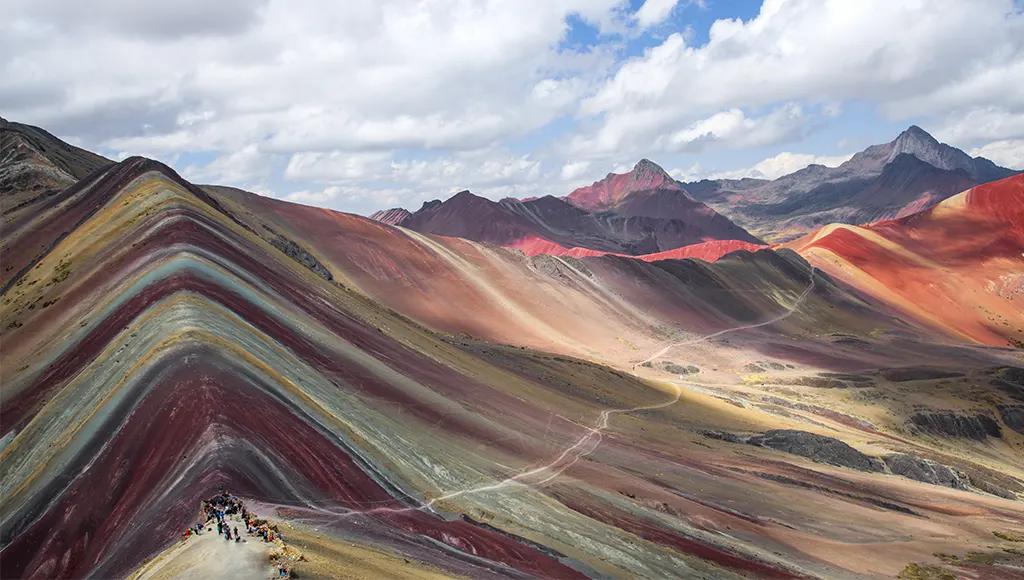
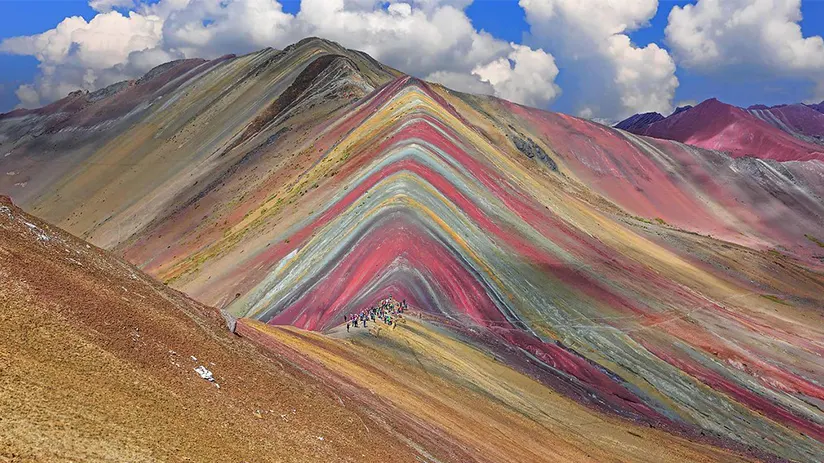
Its soils contain many minerals that modify the color of the mountain surface, creating a rainbow effect. The colors come from different sedimentary layers containing minerals and rock types such as clay, sandstone, marl, quartz-rich sandstone, and iron- and sulfur-bearing compounds. Weathering and oxidation help create the distinctive red, yellow, green, pink, white, and brown tones.
The mountain is known as the Seven-Colored Mountain because of its striking range of mineral tones, which can appear differently depending on the section of the mountain and lighting conditions. Below are some of the vibrant colored stripes of this mountain and their respective minerals:
- Yellow: Calcareous sandstones
- Green: Phyllites, clay
- Pink: Red clay, mudstones, arillites
- Red: Clayey stone, clay
- Brown: Fanglomerate
- White: Quartz, sandstone, marl
Vinicunca Rainbow Mountain: The Classic Hike

Vinicunca is the most popular colorful mountain in Peru and one of the best things to do in Cusco. The name Vinicunca comes from two Quechua terms. ‘Wini’ refers to the rounded black stones found in the area, while ‘kunka’ means ‘neck’, referring to the mountain’s narrow shape.
Parts of the colorful slopes were previously covered by snow and ice. As these coverings receded, the distinctive mineral layers became more visible, and Vinicunca gradually gained international attention. Over time, its uniqueness allowed it to become one of the most famous destinations in the country.
Weather at Vinicunca
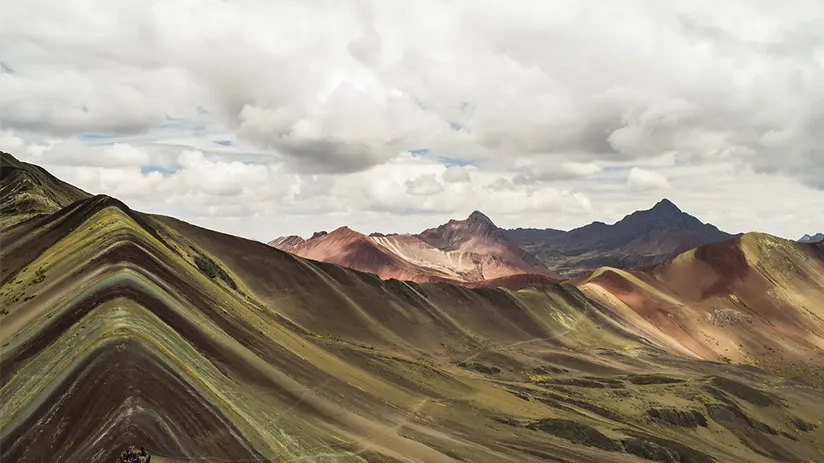
Vinicunca is located over 5,200 meters (17,060 feet) above sea level in the Andes. Temperatures can vary considerably throughout the day. Conditions are often cold, windy, and exposed, particularly at the viewpoint, even during the dry season. Strong winds and high solar radiation are also common, so it’s advisable to take precautions.
How to get to Vinicunca

Most travelers visit Vinicunca from Cusco by organized transportation, traveling through the Cusipata area before continuing to the trailhead. You can choose to book transportation through a travel agency that will pick you up from your hotel. Those who prefer to go independently can take a public van from Huayruropata Street, next to the Cusco Coliseum. Visitors should leave the city between 4:30 and 5:00.
Once in Cusipata, you can make a brief stop for breakfast at one of the local restaurants. The journey continues to Chillihuani, a town at 3,887 meters above sea level. If you’re traveling independently, you’ll need to take a taxi or a shared van for approximately $18 USD per person. To do this, go to the main square of Cusipata and inquire about the service.
From Chillihuani, your adventure in the Peruvian Andes begins with a long hike through the mountains. It is advisable to do some warm-up exercises beforehand and use the clean restrooms in town. The trail is generally recognizable, but the elevation, steep sections, weather, and changing trail conditions can make the hike physically demanding. Horse rental is available for an additional fee, although prices vary by route and current local rates.
Vinicunca Hike
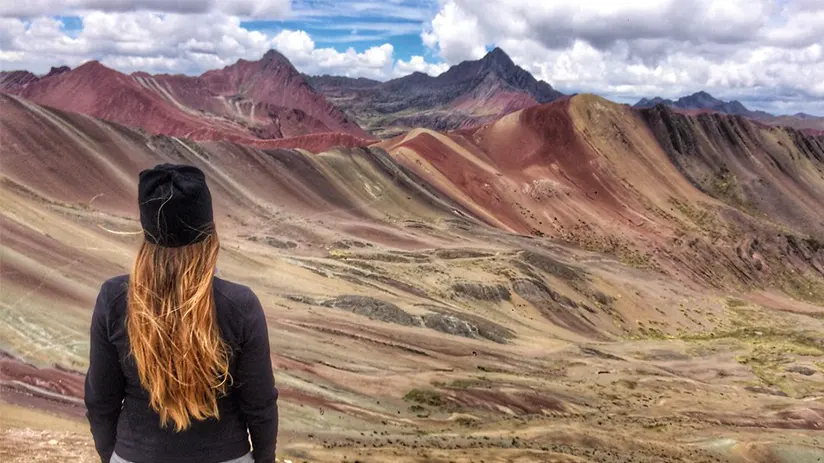
The hike from Chillihuani to the Vinicunca viewpoint takes around two hours. You will pass through high Andean zones and get spectacular views of valleys, ravines, and high plains. Of course, if you have time, you can take a short detour to visit the famous red valley, so called because of the high concentration of iron and clay on its surface.
The trail is generally well marked and begins with a gradual ascent. The trail becomes steeper toward the final section, making the last 30 minutes particularly demanding at this altitude. Keep in mind that you will be hiking at over 4,000 meters. Oxygen levels are lower at high altitudes, so go at your own pace and take it easy.
When you reach the mountain, you’ll be rewarded with natural views. At this elevation, strong winds and intense solar radiation are possible, so wear sunglasses and a hat to protect your eyes and skin. You will have time to take the best pictures with the colorful mountain in the background. Reaching the viewpoint is incredibly rewarding.
Return from Vinicunca

After approximately one hour at the top of the mountain, most visitors begin the return hike. The first 30 minutes of the return involve a steep descent, followed by a more gradual section back to Chillihuani. Visitors arrive at the village of Chillihuani, where they can use the restrooms and board their transport to Cusipata.
If you are traveling independently, you may need to arrange shared or private transportation from Chillihuani to Cusipata. The cost varies depending on the type of transportation and current local rates. In the same way, you can have lunch in any local Cusipata restaurant with a previous payment of approximately $15 USD. After lunch, you will return to Cusco, with the drive taking approximately two hours, depending on traffic and road conditions.
Palccoyo Rainbow Mountain: A Less Demanding Alternative to Vinicunca

Palccoyo (often spelled Palcoyo) is an alternative to Vinicunca because of its similar characteristics. It lies ~100 km southeast of Cusco and farther south than the aforementioned mountain, but it has significant differences. The first is that the hike is generally shorter and less demanding than the classic Vinicunca route. Second, the route can also include a stop in Checacupe, where travelers can visit its historic Inca bridge. The third is that, once at the colorful summit of the mountain, travelers can also visit its stone forest.
Weather at Palccoyo

Palccoyo is located at a high elevation in the Andes, so temperatures can be cold and weather conditions can change quickly. Temperatures range approximately between 5°C and 15°C, but nights are often more challenging, dropping below 0°C. Because of its elevation, the weather can change suddenly, so you should use caution.
How to get to Palccoyo

In the case of Palccoyo, the experience also begins at dawn, from 4:30 to 5:00. The main difference lies in the first destination, which is the town of Checacupe, a small colonial village iconic for its Andean traditions. The drive takes 2 hours and 30 minutes, and the transportation options are the same as for the previous mountain. The regular fare for public buses is approximately $10 USD.
The car will follow the Pitumarca River, iconic for its red color from the clay in its banks and slopes. If you are traveling independently, confirm current transportation options from Checacupe to Palccoyo or Hanchipacha before your trip. We recommend that you hire transportation to wait for you and take you back to Checacupe, which costs around $25 USD. But be careful; the road to Palccoyo is not well signposted.
Palccoyo Hike
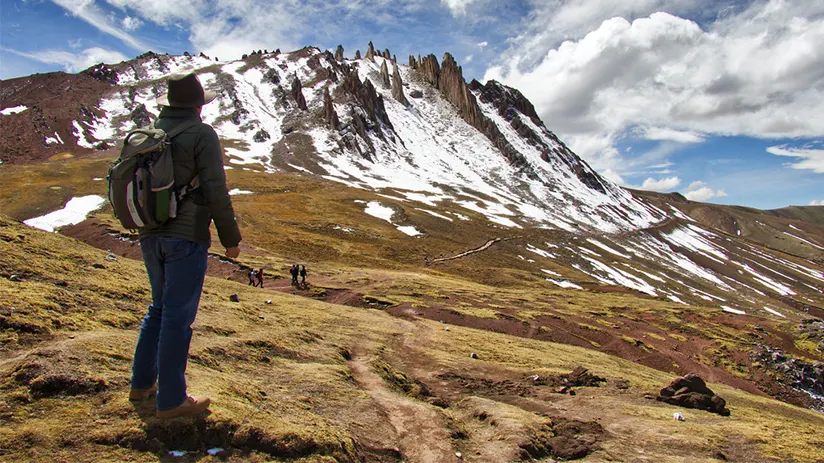
From Checacupe, the route continues toward the rural communities and access points used for the Palccoyo hike. In Hanchipacha, you can use the village bathrooms, stock up on some snacks from the community store, and begin the trek. Visitors will walk through high Andean landscapes at more than 4,500 m.a.s.l.
The route has a gentler slope and is generally less demanding than the Vinicunca hike. The route is generally shorter and less steep than Vinicunca, although trail conditions and signage can vary. Some sections may be less clearly marked than the Vinicunca route, so travelers should confirm current trail conditions and transportation arrangements before visiting.
On the mountain, you will enjoy a landscape of colors. With fewer visitors than Vinicunca, Palccoyo generally offers a quieter setting for photography. The colorful mountain will be your perfect background, and you can capture it from different angles. Next, you can then walk approximately 500 meters to the stone forest, a striking formation of naturally eroded rock pinnacles.
Return from Palccoyo
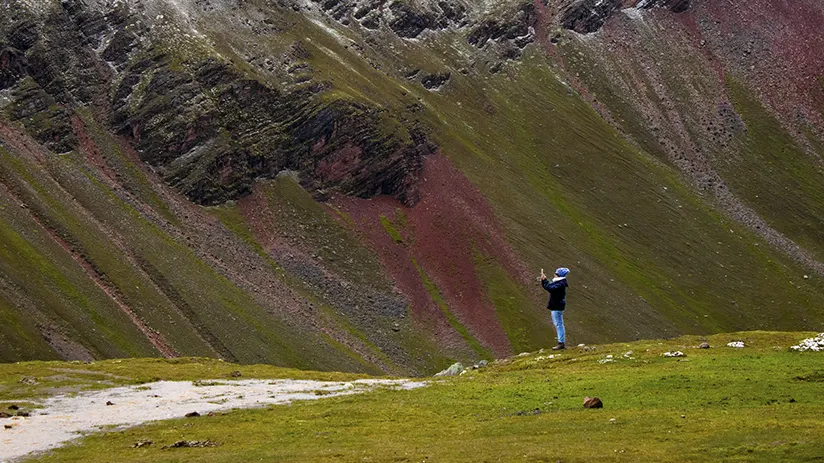
The return journey follows a different path; it has a gentle slope and takes less than an hour. This leads back to the transport location, which is Hanchipacha, so be careful. Next, visitors will return to Checacupe for lunch; the car trip will take about one hour. After that, the transportation will get us back to Cusco.
After a car trip of about 2.5 hours, you’ll arrive in Cusco around 15:30. In the case of solo travel, you must take public transportation from Checacupe’s main square to the Imperial City. The cost of this service is approximately $10 USD. The final stop for both modes of transportation is in Cusco.
Vinicunca vs Palccoyo: Which One Should You Choose?
Choosing between one and the other depends entirely on your interests as a traveler. Both options have advantages and disadvantages that you should consider before making a decision. If you’re still undecided, we’ve provided some helpful information to help you choose and analyze both options. Below is a comparison chart of the characteristics of Vinicunca and Palccoyo:
| Vinicunca | Palccoyo | |
| Location | Near Cusipata/Pitumarca | Near Checacupe |
| Elevation | About 5,200 m (17,060 ft) | About 4,700–4,900 m depending on viewpoint |
| Hiking difficulty | More demanding | Less demanding than Vinicunca |
| Scenery | Famous multicolored mountain + Red Valley option | Several colorful peaks + stone forest |
| Crowds | Usually busier | Generally quieter |
| Best for | Travelers seeking the iconic Rainbow Mountain | Travelers seeking a quieter, shorter alternative |
What to Pack for Rainbow Mountain

Packing properly is one of the best travel tips for Cusco and Peru in general. With such geographical and climatic diversity, deciding what to pack for a pleasant trip can be challenging. Both Rainbow Mountains are no exception because of their considerable altitude. Here’s a brief checklist to help you choose the best items for your full-day tour:
- Hiking shoes or boots with good traction
- Thermal trekking pants
- Moisture-wicking base layer
- Fleece jacket
- Insulated waterproof or water-resistant jacket
- Windbreaker
- Gloves
- Warm hat or beanie
- Sunglasses
- Trekking poles
- Daypack
- Water bottle
- Sunscreen
- Light snacks
Best Time to Visit Rainbow Mountain, Peru

Both Rainbow Mountains are located in the Andes Mountains, resulting in two distinct seasons. The dry season generally runs from May to September, while the wetter months typically extend from November to March. April and October are transitional months, and weather can vary from year to year. Just like the best time to visit Peru, it will depend on your interests and needs as a traveler. Below are some important considerations for each season.
- Dry Season: The dry season generally runs from May to September, although conditions can vary by month and year. Conditions at this elevation can be cold even during the dry season, with strong sun during the day and temperatures that can drop sharply. These months generally offer better trail conditions and a higher chance of clear views, although cold temperatures and strong sunlight remain common.
- Rainy Season: From November to March, this is the rainy season, characterized by cloudy days, frequent rainfall, and muddy trails. Temperatures range approximately from -3°C to 13°C, and for many travelers, these are the most challenging months to visit.
Essential Travel Tips for Rainbow Mountain

Whenever possible, you should research ways to enhance your adventure, not just in the multicolored mountains. Remember that taking precautions is essential, especially for those visiting Peru for the first time. Even experienced visitors can take precautions to improve their experience. Here are some important tips before enjoying your adventure in the heart of the Peruvian Andes.
- Prepare for the high altitude: When hiking through high Andean landscapes, physical and mental preparation is crucial. Pre-trip physical activity, staying hydrated, maintaining a comfortable pace, and taking regular breaks can make the hike more manageable. The high elevation can make even a relatively short hike feel strenuous, particularly if you have not acclimatized to Cusco’s altitude.
- Prioritize your health: Medical services are limited in the mountain areas, so travelers should be prepared and know how to seek assistance if needed. In case of problems, you can go to the nearest town for medical attention. If you have concerns about exercising at high altitude or have an underlying medical condition, consult a qualified healthcare professional before traveling.
- Bring snacks: This recommendation is closely related to the previous one due to the limited access to establishments at high altitudes. Thus, you should buy some small snacks to eat during your trek.
- Combine with other Cusco attractions: Take advantage of the Cusco tourist map and plan your trip so you can combine your visit with other nearby attractions. Some recommended options include the Sacred Valley, Humantay Lagoon, and Machu Picchu, among others.
- Bring cash: As with any other local attraction, you’ll find plenty of casual shopping options, so bring small bills in local currency. Although many establishments now accept card payments, some still don’t. You should also at least familiarize yourself with the basics of the Peruvian currency.
FAQs about the Rainbow Mountain

How difficult is the Rainbow Mountain hike in Peru?
The Vinicunca hike is generally considered challenging because of the elevation and steep sections, even though the route is relatively short. Even though the distance is not very long, the thin air can make it feel much harder, especially for people who are not used to hiking above 4,000 meters.
What is the altitude of Rainbow Mountain, Peru?
Rainbow Mountain, also known as Vinicunca, is located at about 5,200 meters (17,060 feet) above sea level, making altitude one of the main challenges of the hike.
Is Palccoyo or Vinicunca better to visit?
Choose to visit Palccoyo or Vinicunca, depending on what you prefer and your personal travel needs. Vinicunca is more famous and has brighter colors, but it is more crowded and harder to hike. Palccoyo is less crowded, easier to reach, and offers multiple colorful mountains, making it a great alternative for a quieter experience.
How do you get to Rainbow Mountain from Cusco?
Most visitors travel from Cusco to the Cusipata area by organized transportation, then continue to the trailhead near Chillihuani. From there, the hike to the Vinicunca viewpoint generally takes about 1.5–2 hours, depending on pace and conditions.
What is the best time to visit Rainbow Mountain?
The best time to visit Rainbow Mountain is during the dry season, from May to September. During these months, the weather is clearer, and you have a better chance of seeing the mountain’s colorful stripes without clouds or rain.
Do you need a tour to visit Rainbow Mountain in Peru?
A tour is not necessarily required, but many travelers choose an organized excursion because it simplifies transportation and logistics. If you visit independently, confirm current access conditions, transportation, and local regulations before traveling.
Conclusion
Rainbow Mountain Peru offers more than a striking landscape. Vinicunca provides the iconic experience most travelers associate with the Seven-Colored Mountain, while Palccoyo offers a quieter alternative with several colorful peaks and a stone forest. Although the two destinations differ in scenery, crowds, and hiking difficulty, both provide an opportunity to experience the remarkable landscapes of the Peruvian Andes.
Choosing between Vinicunca and Palccoyo ultimately depends on the type of experience you are looking for. Vinicunca is a better choice if you want to see the most famous viewpoint and do not mind a more demanding hike at extreme elevation. Palccoyo may be a better option if you prefer a shorter, less crowded route. Whichever you choose, checking the weather, preparing for the altitude, wearing appropriate clothing, and confirming transportation in advance can make your experience more comfortable and enjoyable.
With the right preparation, a visit to Rainbow Mountain can become one of the most memorable experiences of your time in Peru. From the colorful slopes of Vinicunca to the peaceful landscapes of Palccoyo, these destinations offer a different perspective on the beauty of the Andes. If you are ready to experience Rainbow Mountain for yourself, Machu Travel Peru can help you plan the logistics and make the most of your journey.
The Rainbow Mountain has so much to offer; it can be hard to know where to start. With many years of experience in the tourism sector, Machu Travel Peru is happy to help with anything regarding your trip to the Rainbow Mountain and any tours around it. Let us help you make your Rainbow Mountain travel experience unforgettable! Contact us today to plan your dream adventure!